

On February 22, 1546, the funeral procession for Dr. Martin Luther progressed toward the gates of Wittenberg. Luther died four days earlier, and the news of the Reformer’s death spread rapidly over the German countryside. In his History of Protestantism, J. A. Wylie said, “Few kings have been buried with such honours.” People from every class and occupation joined the procession along the German roads and lanes. The heavy lead casket covered in rich black velvet sat on a carriage drawn by four horses. Behind stretched what appeared to be a huge army of princes, nobles, magistrates, and peasants. In every town along the route, the citizenry thronged the streets and sang. The people, their faces wet with tears, blessed the Reformer’s memory with psalms and hymns. As Wylie put it, “Luther was returning from a great battlefield, where he had encountered the powers and principalities of spiritual despotism, and had discomfited them by the sword of the spirit.”
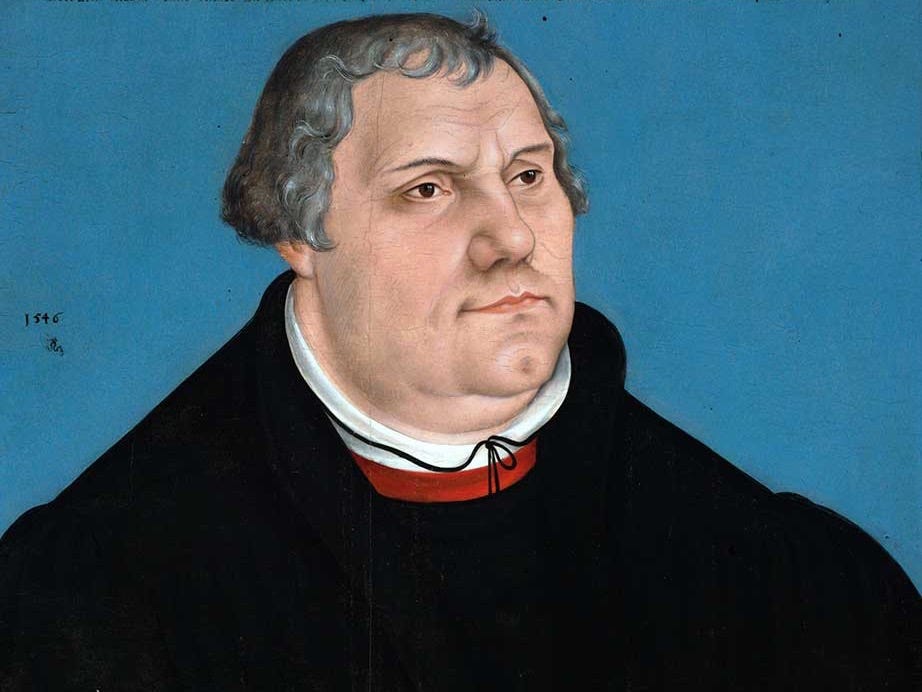
Such an outpouring of emotion was the tribute to a man who stood against the corruption of the papal religion and gained an enduring victory. The previous month, Luther received a request to travel to his native area to resolve a dispute over boundary lines between the holdings of two of the Counts of Mansfeld. He became ill during his journey, but recovered and declined to turn back toward Wittenberg. When he approached Eisleben, more than one hundred men on horseback escorted him into the town, where he took lodgings at their expense. One wrote that he “entered the town more like a prince than a prophet, amidst the salute of cannon and the ringing of the bells in all the churches.” It was his final journey in this life. He did the business for which he traveled and remained in the town to preach and partake of Communion.
On February 17, he had dinner with his friends and his three sons: John, Martin, and Paul. Justus Jonas, a friend from Wittenberg who had accompanied him, joined them at the table that evening. After dinner, Luther began to suffer his customary pain in his stomach. After a short nap, he retired to his room and lay on his bed. Before very long, he awoke, feeling tremendous pressure in his chest, and sensed that the hour of his death was at hand. Having summoned assistance, he then prayed to God, “I beseech thee, my Lord Jesus Christ, receive my soul. O heavenly Father, though I be snatched out of this life; though I must now lay down this body; yet know I assuredly that I shall abide with thee for ever, and that no man can pluck me out of thy hands.” His breathing grew shallower, and three times he uttered the words, each time a little more faintly, “Into thy hands I commit my spirit; thou hast redeemed me, O God of truth!”
Luther’s death marked the end of the first major era of the Protestant Reformation. After that point, the emphasis shifted away from Germany, where his successors frittered away much of what he accomplished.
Luther was an advocate of education for all children. He taught children and urged that all children should learn to read and write so they could read the Bible and transmit it to others. He also led the way in the establishment of Protestant seminaries. It was always his objective in teaching young boys to be aware of those who could become preachers of the Word. The man who lived in the liberty of the gospel of Christ died in that same liberty. He had no second thoughts. The gospel triumphed in his soul, and his death was a testimony to it. The Scriptures Alone. Grace Alone. Faith Alone. Christ Alone. For the Glory of God Alone. The gospel he preached was free justification, a gospel that set people free to serve God.
In the Castle Church in Wittenberg, the congregation sang some funeral hymns, and then, Pomeranus, one of Luther’s colleagues, climbed the steps of the pulpit to deliver the funeral sermon. Dr. Philip Melanchthon delivered a separate oration in which he said of Luther, “He elucidated the doctrine of Paul which says, that man is justified by faith; he showed the difference between the law and the gospel, between spiritual righteousness and the moral law; he pointed out the nature of true prayer, and he called back the church universal from that heathen madness which teaches that God, is to be invoked even when the mind, oppressed with metaphysical doubts, is flying far from him: he enforced on us the conviction that prayer is to be made in faith, and in a good conscience, and he led us to the one mediator, the Son of God sitting at the right hand of the Eternal Father, and interceding for us.”
In the stillness of the church, sobs arose from princes, magistrates, pastors, and other citizens who were gathered around Martin Luther’s open grave in the floor of the church. The pallbearers lowered the casket into the grave. They filled the grave and fitted the gravestone into place. Martin Luther was at rest in Jesus.
Few people had the impact on the history of the world that Luther had. Sadly, Luther’s legacy is in disrepute, even by those whose denomination bears his name. They judge him by the standards of their compromise and ecumenism and find him, in their view, sorely lacking.
But in Calvin’s Geneva, in Knox’s Scotland, in Northern Ireland, and in North America, that legacy has gone forth. It is the legacy of the preaching of Christ and Him crucified.
The legacy of Martin Luther appears in three areas that are the core of Protestantism.
Literacy—the reading of the Bible and education of children and adults to that end. Luther understood that the Bible alone was the foundation of the Christian faith. He underscored the doctrine of the infallibility of the Scriptures, pointing to the impact of their miraculous inspiration. Luther argued that the Scriptures are without error, meaning that they have inherently divine authority on every subject on which they speak. He argued for the doctrine of the perspicuity of the Scriptures, meaning that what anyone needs to know for salvation appears clearly and directly in the Bible. Luther maintained the truth that the Bible contains things that require study, but that the book is clear and open to everyone.
Liberty—the priesthood of every believer. Luther’s position was that every Christian may approach God individually, and may interpret the Scriptures according to the conscience that the Holy Spirit informs and directs.
Liveliness—the joy of family life and the heritage that must pass from one generation to the next. Luther grasped the truth that true Christians have their eyes on the generations that follow them, and that the joy of their upward look must impress those generations with the truth of gospel doctrine.
Melanchthon, on receiving the news of Luther’s death, interrupted his lecture to say, “It was not human brilliance that discovered the doctrine of the forgiveness of sin and of faith in the Son of God, but God who raised him up before our very eyes, who has revealed these truths through him. Let us hold dear the memory of this man and the doctrine in the very manner in which he delivered it to us.” Luther’s works occupy more than a hundred volumes, but he said, “I’d rather that all my books would disappear and the Holy Scriptures alone would be read.” Luther’s lasting legacy is the doctrine of justification by grace through faith alone in Christ alone, but he asserted the truth that the doctrine of free justification, like every aspect of gospel truth, rests on the foundation of the Scriptures of Truth.
Rev. David Mook | Retired minister, formerly Phoenix, AZ